Related Resources
New report sheds light on payment flows in the pharmaceutical supply chain, including the role of 340B and vertical integration
A new report explains the flow of dollars through the pharmaceutical supply chain for commercially insured patients taking retail medicines and details how transactions between stakeholders affect patient costs at the pharmacy counter. The report also highlights how the 340B hospital markup program and increased consolidation and vertical integration among supply chain entities raises the cost of medicines for patients and employers.
The path a medicine takes from the biopharmaceutical manufacturer to the patient involves a complex supply chain, including wholesalers, pharmacy benefit managers (PBMs), insurers, and pharmacies.
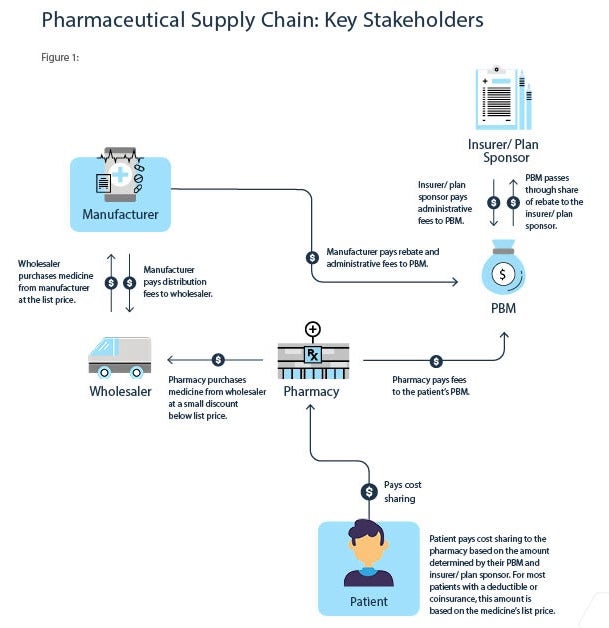
The report provides three hypothetical examples to illustrate how payments flow through the supply chain when a patient is purchasing a medicine in their deductible, with a copay or at a 340B contract pharmacy.
Middlemen pocket savings meant for patients.
Manufacturers provide billions in rebates and discounts to PBMs and insurers, which can lower a medicine’s average net price by 50% or more. However, PBMs and insurers rarely pass these savings to patients at the pharmacy counter, often leaving patients to pay more than their insurer or PBM. Rebates and discounts are often tied to the list price of medicines, which experts have noted may incentivize PBMs and insurers to favor drugs with higher list prices over lower cost alternatives. At the same time, insurers shift costs onto patients through high deductibles and coinsurance, which are also often based on the list prices.
Here is an example of what happens when a patient fills a prescription and has not yet met their deductible:
- Jane takes a blood pressure medicine with a $100 list price. Because Jane hasn’t met her deductible, her insurer does not cover any costs for this prescription. Her PBM, however, still receives a rebate from the manufacturer, and shares a portion with the insurer. The PBM and insurer earn $10.65 and $23.10, respectively, from rebates and fees, while Jane pays $101.10 – a higher price than any stakeholder in the supply chain.
Here is an example of what happens when a patient fills a prescription and has met their deductible but has a required copayment:
- Erik takes a blood pressure medicine with a $100 list price and has met his deductible. He pays a $40 copayment. The insurer/ plan sponsor spends $38 after accounting for the rebates and fees they receive. Ultimately, Erik pays more for his medicine than his insurer and PBM.
Big, tax-exempt hospitals and clinics abuse the 340B program by marking up medicines.
The 340B hospital markup program allows big, tax-exempt hospitals and clinics to purchase medicines at a low cost, sometimes as low as a penny, and then significantly mark up the price. When the medicines are dispensed at a contract pharmacy, patients, insurers, and employers pay the full marked-up price which is a hidden tax on medicines.
Here is an example of what happens when a patient fills a 340B eligible prescription at a 340B contract pharmacy:
- Scott takes a blood pressure medicine with a $100 list price and fills it at a 340B contract pharmacy. The 340B hospital buys the medicine for $28, dispenses it through its contract pharmacy and receives $100.85 in return. The patient pays $40 in cost sharing and gets no benefit from the 340B discounted price. That means the hospital paid less than the patient while profiting $57.60 and earning twice as much as the manufacturer.
Vertical integration and consolidation put profits before patients.
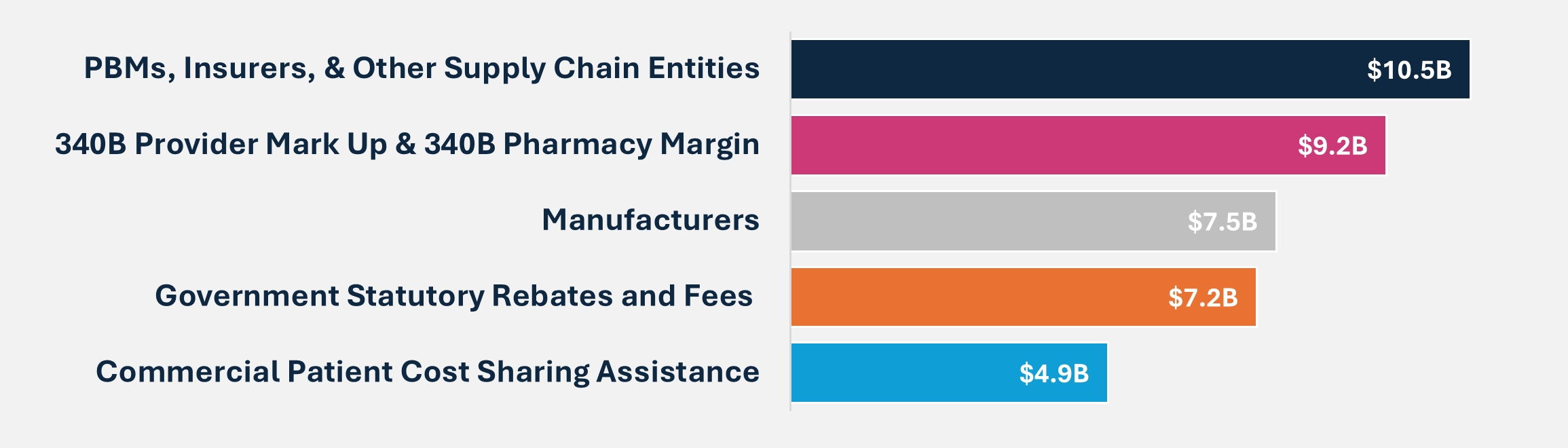
The increase of vertical integration and consolidation among insurers, PBMs, pharmacies and providers has enabled these organizations to profit from nearly every transaction in the pharmaceutical supply chain through fees, spread pricing, and opaque practices. In fact, half of every dollar spent on medicines goes to middlemen and others that do not make the medicine, highlighting a growing problem that spending on medicines is increasingly being used to subsidize many parts of the health care system, often at the expense of patients.
Middlemen control what patients pay at the pharmacy counter, as well as which medicines patients can get and where they can get them. Vertical integration also financially incentivizes PBMs to steer patients towards the pharmacies they own.
To treat the problem, we must diagnose it correctly first. For policymakers to address rising health care costs, they must address where half of prescription drug spending is going – to entities that do not make medicines.
View the full report here and patient examples here.
Rachel Weissman
February 13, 2025
Follow the Dollar report preview
340B spending is exploding, forcing prices up for patients, employers and government programs
Year after year, the 340B program continues to balloon at a rate unseen in any other part of health care. 340B hospitals and grantees purchased more than $66 billion of medicines at discounted 340B prices according to new figures from HRSA – a nearly 24% increase compared to 2022 purchases. For comparison, total net spending by insurers and patients on all medicines increased only 5.6%, on average, over the past five years. And net prices for medicines are generally flat or falling.
There is scant evidence that these reduced prices are reaching all of us who utilize hospital services, much less the vulnerable patients this program was designed to help. Instead, evidence suggests many 340B hospitals pocket the revenue they generated from the program and use it to expand their reach into wealthier areas, fund building upgrades, pay executive bonuses, and even cover the salary of football coaches. This constitutes a “hidden tax” that is borne by all of us – taxpayers, employers, and most importantly, the vulnerable patients that the program is supposed to help. Here’s what this looks like:
- Higher costs for employers. An IQVIA analysis found that 340B increases self-insured employers’ drug costs by more than 4%, resulting in about $5 billion in lost revenue per year. The analysis was conducted before this latest government data release, and it’s likely that the cost to employers is growing as fast as the 340B program.
- Higher costs for states and taxpayers. There is also evidence that 340B is harming Medicaid budgets, too. One analysis found that as 340B providers proliferated, Medicaid spending rose. The more 340B sites that opened, the more Medicaid spending increased, straining state budgets.
- Higher costs for everyone. Because 340B hospitals are at a competitive advantage relative to non-340B hospitals, the program incentivizes hospitals and health systems to gobble up independent physician practices and convert them into outpatient departments of 340B hospitals, fundamentally distorting local health care markets. This drives increased prices as competition diminishes and care shifts from physician offices to higher cost hospital settings, helping to explain the impact on Medicaid and other health care spending.
Considering all these facts, it begs the question – if the savings aren’t making their way to patients, where is all this money going? Here’s how it works:
- 340B hospitals and grantees purchase medicines at prices that are, on average, 57% below the list price, but can be as low as a penny. They often turn around and charge patients, employers, and taxpayers full price. Reports show they even assign medical debt to patients based on the marked-up price.
- According to IQVIA, 340B sales to hospitals and grantees increased more than three times faster than non-340B sales between 2018 and 2023 when measured at the estimated list price (129.4% vs. 41.4%, respectively).
Given the negative repercussions across the system, policymakers are starting to take notice and have proposed comprehensive reforms to the 340B program. It’s time for 340B to get back on track and working for those it was originally intended to serve - vulnerable patients and communities.
Drew Voytal
November 13, 2024
"340B spending is exploding, forcing prices up for patients, employers and government programs"
NYT exposes hospitals, middlemen make millions off a hospital markup program
A ground-breaking New York Times investigation reveals how a for-profit federal contractor helps hospitals abuse the 340B program to charge huge markups on medicines. 340B has become a tool for profit, benefiting large hospital systems and private corporations far more than the patients it was designed to serve. Here is what the New York Times uncovered:
340B hospital markups drive billions in profit for hospitals, middlemen.
Virginia King, a cancer patient from Santa Fe, NM, received a cancer medicine whose price was drastically marked up by the hospital. The hospital paid only $2,700 for the drug through the 340B program yet billed her insurance $22,700.
“She had unknowingly sought care from a hospital that participates in a federal program allowing it to buy drugs at a steep discount and charge patients and insurers a higher amount, keeping the difference.”
The hospital didn’t stop there. They sent Virginia to debt collection for an additional $2,500 – “more than half my take-home salary for a month” she told the Times.
340B abuse is a hidden tax on employers, patients and taxpayers.
340B, which began as a small program to help safety-net providers expand care for needy patients, has seen explosive growth with little evidence of patient benefit.
“Now, more than half of nonprofit hospitals in the United States take part. While some providers say it has helped keep their doors open, others — especially large nonprofit health systems — have been accused of maximizing payouts and swallowing the profits.”
“The program’s escalation has driven up health care costs for employers, patients and taxpayers, studies show.”
Loopholes to maximize profits.
Apexus, the for-profit company chosen by the federal government to help administer the 340B program, “has worked behind the scenes to supercharge the program.” More medicines to mark up means more profit for hospitals, middlemen --such as Apexus-- and other actors taking advantage of the program.
“...Apexus is allowed to collect a fee for almost every drug sold under the program, giving the company an incentive to help hospitals and clinics capture as many prescriptions as possible …”
“The numbers and the growth were staggering…We all bear the cost.”
No guardrails or oversight gives bad actors free rein.
There is a severe lack of transparency and oversight of the 340B program, with the New York Times noting that there are few rules to ensure patients are benefitting from the program. “Although the money is supposed to encourage care for impoverished patients, there are few rules to enforce that.
“Patients rarely know they are part of this system. Their prescriptions can be counted as 340B when they get outpatient treatment at a hospital or clinic that qualifies for the program, regardless of the patients’ own income or insurance status. The provider can continue to make money off the patients’ future outpatient prescriptions, even if they get them somewhere else.”
This investigation from the New York Times is yet one more clear piece of evidence that the 340B Hospital Markup Program is deeply broken and in desperate need of reform.
Policymakers need to put forth comprehensive reforms to hold 340B hospitals and middlemen accountable for their greedy behavior.
Drew Voytal
January 15, 2025
woman reviewing prescription bottle
New study: Entities that don’t make medicines get half of what is spent on those medicines
Elizabeth Carpenter
January 7, 2025
New study: Entities that don’t make medicines get half of what is spent on those medicines
New 340B report from Minnesota exposes steep hospital markups on medicines, patient benefits remain unclear
Large hospitals and clinics in Minnesota reported marking up the prices of medicines by at least a total of $630 million in 2023, though the actual amount may be much higher. A new 340B transparency report from the Minnesota Department of Health reveals stark inequities in how Minnesota hospitals, health care providers, and ultimately patients benefit from the thirty-year-old 340B program. Designed to support eligible safety-net providers that serve large vulnerable populations, the report shows 340B in Minnesota instead disproportionately benefits large hospital systems and for-profit middlemen, like contract pharmacies and third-party administrators, raising serious concerns about whether vulnerable patients are ultimately benefiting.
Key findings from the report show that just a small fraction of participating Minnesota hospitals generate the most profits from the program. However, according to charity care data that hospitals report to the federal government, many of these same hospitals fail to provide charity care or community benefits proportional to their financial gains from these markups. The Minnesota report also sheds new light on how for-profit middlemen have made millions of dollars off of this important safety net program.
The report is a step in the right direction toward much-needed transparency by bringing to light important details of the 340B program. However, serious questions remain.
- What are these tax-exempt hospitals doing with the $630 million in 340B profit they made from their medicine markups? Charity care data provided to the federal government by many of the hospitals in the report show these profits are not helping low-income and uninsured patients afford the care they need.
- Why are large hospitals and for-profit entities reaping hundreds of millions of dollars in profit from 340B, while some safety net clinics operated their 340B programs at a loss? 13% of participants (primarily large hospitals) generated $500 million of the $630 million in reported 340B profits. The program was created to help vulnerable patients, not maximize profits for large hospitals, pharmacy chains and PBMs.
- Why are these for-profit entities making so much money off of this safety-net program? Partial reporting shows for-profit contract pharmacies and third-party administrators generated at least $120 million in fees from the program in 2023, representing approximately $16 out of every $100 in 340B profits.
- If this report “substantially underestimates” hospital profits from 340B markups, how much larger could the problem actually be? Most hospitals and clinics did not report data on provider-administered drugs, which includes many cancer medicines, and account for about 80% of 340B spending.
Laudably, the findings suggest a small fraction of clinics serving vulnerable patients do pass 340B discounts directly to them. Conversely, the report also shows that the program, as implemented, mostly benefits large institutions and for-profit middlemen with no evidence these entities use 340B-generated profits to support underserved patients. Minnesota hospitals, and indeed hospitals around the country, must answer these tough questions. Policymakers must demand greater transparency and accountability from hospitals to ensure 340B funds are used as intended. Mandating reporting on 340B profits, tailoring use of contract pharmacies to ensure access for vulnerable patients and rebalancing the program to support true safety-net providers and the vulnerable patients they serve are critical steps to reform 340B at the federal level.
Without clear accountability, the program risks perpetuating inequities and further undermining its original purpose.
Drew Voytal
November 27, 2024
concerned patient
PhRMA urges HRSA not to impede new 340B pricing approaches to improve transparency and integrity
In a letter submitted to the Health Resources and Services Administration (HRSA) last week, PhRMA expressed serious concerns regarding the agency’s recent public statements about use of rebates to offer 340B ceiling prices to covered entities. PhRMA’s letter detailed persistent abuses and instances of some covered entities breaking the law in the 340B drug pricing program — and how the 340B statute contemplates manufacturers implementing alternative approaches to providing 340B prices that increase transparency and improve program integrity. Our letter to HRSA outlines the following:
As the 340B program continues to balloon in size, the Department of Health and Human Services (HHS) has not taken necessary action to prevent statutory 340B/Medicaid duplicate discount violations.
- 340B is the second largest federal prescription drug program, behind only Medicare Part D. Nearly 60% of all hospitals participate in 340B. The program’s unrestrained growth has exacerbated program integrity challenges, and HRSA’s oversight has not kept pace. For example, HRSA has failed to ensure that manufacturers have access to even basic information about their medicines on which 340B pricing is requested. Covered entities have also resisted this transparency, including efforts to require covered entities to report how much money they are making from the program.
- Government watchdogs like the Government Accountability Office and HHS Office of Inspector General have repeatedly highlighted the pervasive issue of 340B/Medicaid “duplicate discount” violations. This is when covered entities, such as hospitals, purchase a drug at the discounted 340B price while the drug also generates a Medicaid rebate. Duplicate discounts are an absolute prohibition under the law, but the issue has gone largely unaddressed. Worse, new requirements under the Inflation Reduction Act (IRA) would actually increase duplicate discount risks.
- HRSA’s own covered entity audits suggest a concerning trend of non-compliance. However, when audits find program violations, they almost never result in penalties. It has also become more common for covered entities to try to thwart manufacturer audits by refusing to cooperate or even suing HRSA to try to stop the audits. Covered entities’ resistance to transparency on the front end while simultaneously resisting audits to remedy non-compliance on the back end highlights the need for a new approach.
Manufacturers want to make sure the requirements in the 340B law are met, and rebates are a common-sense approach used in numerous other federal health care programs.
- When the 340B program was first created in 1992, U.S. health care looked very different than it does today. 340B must be modernized to reflect the realities of our current health system. To that end, manufacturers are working to address long-standing program violations and bring 340B in line with new policies like the IRA.
- One possible approach is implementing a rebate model, which would provide manufacturers with information about 340B purchases before providing discounted pricing, thereby preventing program violations in the first place. Rebates are a common form of discount used in many other federal health care programs and would help improve integrity and transparency in 340B.
- Rebates are explicitly mentioned in the 340B statute as a possible mechanism for offering reduced pricing to covered entities. Given the well-documented history of program violations, it would be wrong for HRSA to reject a rebate model without considering the increased transparency and program integrity improvements such a model could offer.
The profits covered entities generate through the 340B program should be used to help low-income, uninsured and other vulnerable patient populations access affordable medicines. Instead, the inadequacy of procedures to prevent duplicate discounts, along with other abuses in the system are enabling large, for-profit corporations to line their own pockets, raising costs for patients, employers and the government. It’s past time to get 340B back on track and working for patients.
Read the full letter.
Drew Voytal
October 18, 2024
PhRMA urges HRSA not to impede new 340B pricing approaches to improve transparency and integrity